

What a "Professional Profile" Actually Is — and What It's Made Of
When people talk about a "professional profile," most think of a resume or a LinkedIn page. But your profile is actually a much broader concept. It's the sum of everything other people see, hear, or find about you in a professional context: how you introduce yourself, how you talk about your experience, which projects you mention, how you handle difficult situations, what comes up when someone searches your name online. Each of these elements may seem minor on its own. But together they add up to a coherent impression. Sometimes that impression aligns with how you want an employer to see you. Sometimes it doesn't. The important thing is that your profile exists regardless. The only question is whether you're shaping it deliberately — or letting it form on its own from whatever happens to be out there.
How Employers and Recruiters "Read" a Candidate Before the First Meeting
Before you walk into an interview, the recruiter or hiring manager has already formed an impression of you. Where does it come from? From your resume — and here it's not just what's written, but how it's structured and whether the logic holds. From your cover letter, if there is one. From your online presence — especially if your field involves any public visibility. Even if you have no personal website or public profiles, the absence of any information creates its own impression. Also — if the recruiter knows anyone from your previous employers or teams, they may ask about you informally. The reputation that lives in those conversations often carries more weight than any resume. All of this happens before you even walk in the door. That's exactly why it's worth knowing what image is forming about you on the outside.
Your Photo, Tone, and Presentation: How Small Details Shape the Big Picture
There are details that people overlook but that meaningfully impact how they're perceived. Your photo: in fields where a profile photo is the norm, it should look like someone you'd expect to see in that role. It doesn't have to be a formal studio shot — but it should be clear, with a neutral background and a natural expression. Blurry or heavily filtered is actually worse than no photo at all. Tone in written communication: how you write emails, messages, and requests all carry information. Some people write with structure and clarity. Others write in long, unstructured blocks where the main point gets buried. Others don't respond at all, or reply with a one-word "ok" to something important. All of that forms an impression, even if you don't think of it as part of your professional profile. How you talk about your experience: do you have a clear, consistent professional narrative, or does it feel a little different every time you explain who you are and what you've done?
What Your Past Roles Say About You — Even If You're Not Aware of It
Each of your previous roles says something about you — regardless of whether you're actively communicating it. For example: if you stayed at one company for a long time, that can read as loyalty and stability, or as resistance to change — depending on the context and how you talk about it. If you have several short stints in a row, a recruiter might see instability, or — if you frame it right — deliberate development through diverse experience. If you've always been in individual contributor roles but are now going for a management position, your history doesn't directly demonstrate that capability, and you'll want a prepared argument. The point is: these signals in your resume exist whether you manage them or not. Your job is to know they're there — and either address them proactively, or frame your experience in a way that leads the reader to the conclusion you want.
How to Deliberately Build the Image That Works in Your Favor
Building your professional image deliberately isn't about pretending to be someone you're not. It's about making sure your real qualities and experience are presented in a way that actually helps you move toward where you want to go. A few practical steps. First, get clear on what kind of professional you want to be known as. Not "a good employee in general," but specifically: what's your specialization, what's your edge, what problem do you solve better than most? Second, check whether your resume, the way you introduce yourself, and your behavior in team settings all reflect that image. If there's a gap between who you want to be seen as and how you're actually coming across — that's worth working on. Third, be consistent. A professional image isn't built on one standout moment — it's built through regular, everyday behavior. Someone who comes across differently every time is harder to read and harder to remember.
How to Audit Your Current Profile and What to Fix Today
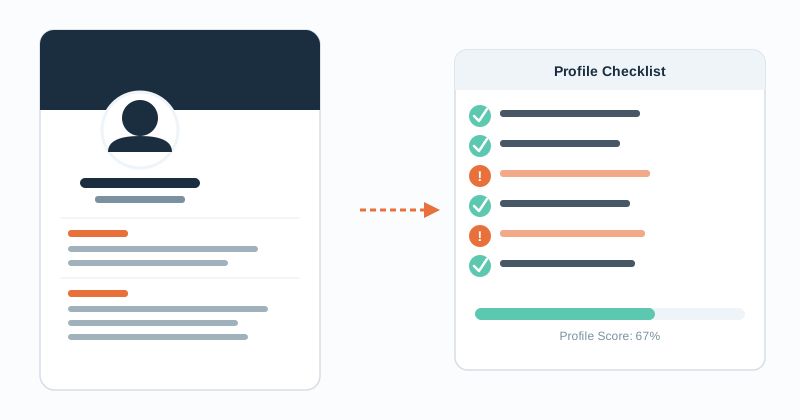
Here are a few concrete things you can do right now. Type your name into a search engine and see what comes up. Is there anything you wouldn't want a potential employer to see? Open your resume and read it as if you're seeing this person for the first time. Is it clear who they are and what their edge is? Are there real results, or just a list of duties? Ask someone who knows your work well to honestly answer: "What's the first word that comes to mind when you think of me as a professional?" The answer might surprise you — in a good way or a challenging one. Look at your profile photo and the tone of your recent professional messages. Do they reflect the image you're trying to build? These small checks take about an hour. But the results can shift how you're perceived in ways that run much deeper than you'd expect.